Tuesday, November 20, 2018

ADULT ORTHODONTICS


Overview

Orthodontics is a specialty discipline of dentistry that focuses on alignment of the teeth and jaws to improve a person’s smile and oral health. Orthodontists will diagnose, treat and prevent irregularities of the teeth with the use of braces, which are fixed dental appliances, and removable dental appliances, when the braces are removed. These devices can be used to straighten teeth, correct an irregular bite, close unsightly gaps and bring teeth and lips into proper alignment. Crooked teeth that do not fit together correctly are harder to keep clean and are at risk of being lost early because of tooth decay or periodontal disease.


Benefits

The benefits of orthodontics include a healthier mouth, a more pleasing appearance, and teeth that are more likely to last a lifetime.


Care

Good oral hygiene is especially important when you have braces or other orthodontic appliances. Brushing twice a day with fluoride toothpaste for two minutes, flossing daily, and scheduling ongoing dental visits are all important to help keep the gums and teeth healthy.

Patients with braces should maintain a balanced diet and limit sugary snacks between meals. Your dentist may recommend avoiding certain foods that could interfere with braces or accidentally bend the wires, such as nuts, popcorn, hard candy, ice and sticky foods, such as chewing gum, caramel or other chewy candy.


Procedure

There are a variety of options, both fixed and removable, which help move teeth, retain muscles and affect the growth of the jaws. They work by placing gentle pressure on the teeth as they move in the jaw bone.

Traditional Braces

The most common fixed treatment option, braces consist of brackets, elastic bands and an arch wire. Brackets are bonded to the front of the tooth and used as anchors for the braces. Arch wires are placed through the brackets and small elastic bands secure the arch wire in the bracket. Tightening the arch wire puts tension on the teeth, gradually moving them into proper position. Orthodontists adjust braces every 4-6 weeks to bring about the desired results, which may be achieved in one to three years.

Today's braces are smaller, lighter and show far less metal than in the past. They come in bright colors for kids, and clear styles preferred by many adults.

Once braces are removed, a retainer is worn on both the upper and lower jaws (or where the braces were placed originally) for at least one year to hold the teeth into place in their new position.

Although a little discomfort is expected during orthodontic treatment, today's braces are more comfortable than ever before. Newer orthodontic techniques and materials have been developed to move teeth in a shorter period of time.

Here’s an overview of some of the other orthodontic treatment options:

Damon Braces

Damon braces are self-ligating appliances, meaning that instead of using elastic bands to attach the arch wire to the bracket, the brackets use a slide mechanism. This eliminates the need for elastic bands, which cause friction and can slow down treatment. With damon braces teeth can move into place more freely so treatment time is decreased. Damon braces are more aesthetically pleasing because the brackets are less noticeable than traditional metal brackets. The downside is that damon braces are usually more expensive than traditional braces. Consult with your orthodontist to find out if damon braces are a good option for you.


Invisalign

Invisalign is a set of custom-made clear plastic aligners, which are designed to shift your teeth into the proper position. About twice a month, the patient switches to a new set of aligner trays, repeating this until their teeth are in the correct position. Invisalign is intended to deliver the same benefits as traditional braces but the aligner trays are less noticeable, offering an aesthetic advantage. The aligners are removed for eating, brushing and flossing, and may not take as long to achieve good results as braces during orthodontic treatment.

Lingual Braces

Lingual braces, also called invisible braces, are placed on the interior side of the teeth (by the tongue and palate) and are a great option for people concerned about their appearance. Similar to traditional braces, teeth are straightened using continuous gentle pressure to help them slowly shift into the proper position. Lingual braces involve more customization and may be more expensive than traditional braces.

Although treatment plans are customized, most people wear braces from one to three years, depending on their individual needs and the position of their teeth and occlusion.

What Are Dental Crowns And Tooth Bridges?


What are Dental Crowns and Tooth Bridges?

Both crowns and most bridges are fixed prosthetic devices. Unlike removable devices such as dentures, which you can take out and clean daily, crowns and bridges are cemented onto existing teeth or implants, and can only be removed by a dentist.

How do Crowns Work?

A crown is used to entirely cover or "cap" a damaged tooth. Besides strengthening a damaged tooth, a crown can be used to improve its appearance, shape or alignment. A crown can also be placed on top of an implant to provide a tooth-like shape and structure for function. Porcelain or ceramic crowns can be matched to the color of your natural teeth. Other materials include gold and metal alloys, acrylic and ceramic. These alloys are generally stronger than porcelain and may be recommended for back teeth. Porcelain bonded to a metal shell is often used because it is both strong and attractive.

Your dentist may recommend a crown to:

Replace a large filling when there isn't enough tooth remaining
Protect a weak tooth from fracturing
Restore a fractured tooth
Attach a bridge
Cover a dental implant
Cover a discolored or poorly shaped tooth
Cover a tooth that has had root canal treatment

How do Bridges Work?

A bridge may be recommended if you're missing one or more teeth. Gaps left by missing teeth eventually cause the remaining teeth to rotate or shift into the empty spaces, resulting in a bad bite. The imbalance caused by missing teeth can also lead to gum disease and temporomandibular joint (TMJ) disorders.

Bridges are commonly used to replace one or more missing teeth. They span the space where the teeth are missing. Bridges are cemented to the natural teeth or implants surrounding the empty space. These teeth, called abutments, serve as anchors for the bridge. A replacement tooth, called a pontic, is attached to the crowns that cover the abutments. As with crowns, you have a choice of materials for bridges. Your dentist can help you decide which to use, based on the location of the missing tooth (or teeth), its function, aesthetic considerations and cost. Porcelain or ceramic bridges can be matched to the color of your natural teeth.

How are Crowns and Bridges Made?

Before either a crown or a bridge can be made, the tooth (or teeth) must be reduced in size so that the crown or bridge will fit over it properly. After reducing the tooth/teeth, your dentist will take an impression to provide an exact mold for the crown or bridge. If porcelain is to be used, your dentist will determine the correct shade for the crown or bridge to match the color of your existing teeth.

Using this impression, a dental lab then makes your crown or bridge, in the material your dentist specifies. A temporary crown or bridge will be put in place to cover the prepared tooth while the permanent crown or bridge is being made. When the permanent crown or bridge is ready, the temporary crown or bridge is removed, and the new crown or bridge is cemented over your prepared tooth or teeth.

How Long do Crowns and Bridges Last?

While crowns and bridges can last a lifetime, they do sometimes come loose or fall out. The most important step you can take to ensure the longevity of your crown or bridge is to practice good oral hygiene. A bridge can lose its support if the teeth or bone holding it in place are damaged by dental disease. Keep your gums and teeth healthy by Brushing with fluoride toothpaste twice a day and flossing daily. Also see your dentist and hygienist regularly for checkups and professional cleanings.

To prevent damage to your new crown or bridge, avoid chewing hard foods, ice or other hard objects.

Crowns

 
                    Full porcelain fused to metal.


                           Full cast gold crown.


Bridges


Teeth around the space are prepared. 

The bridge is mounted and adjusted for fit and comfort. 

The bridge is cemented into position.


“LOSING YOUR FRONT TEETH IS REALLY QUITE TRAUMATIC. BEING ABLE TO HAVE THAT BACK HAS MADE SUCH A DIFFERENCE”


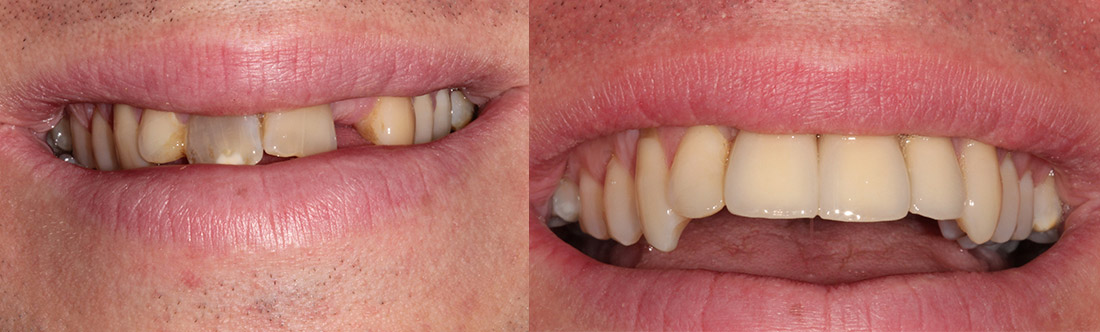
After cracking his front three teeth during a round the world yacht race, Daniel opted for a replacement denture to help with the aesthetic appearance of his smile. Living with a denture, however, was proving extremely difficult and uncomfortable. He couldn’t eat certain foods and as a naturally active and sociable person, he felt the denture was limiting his lifestyle. Daniel came to Dental clinic  after a friend recommended dental implants. After a consultation with  Dental implantologist , Daniel agreed that, as a permanent and fixed solution, implants were his best option.

“I did a round the world yacht race, had an accident and cracked my front three teeth.” Said Daniel.

“One of the three teeth had really started to go black and it was affecting my confidence, I was having to be careful about what I ate. Fortunately, a friend of mine, who had recently just finished having an implant, mentioned that she’d come here to  Dental clinic .”

Daniel’s treatment involved 3 implants to replace his front 3 teeth, along with some tooth whitening to brighten the colour of his remaining teeth. The outcome was a winning smile and the ability to eat whatever he wanted without the worry of his denture slipping or coming out.


“I was absolutely so pleased, it made such a difference,” said Daniel. “To be able to smile in photos and the lovely feeling of crunching on an apple properly, putting it in your mouth and hearing the crunch, savouring it and knowing that you’re not going to have a denture come out, it’s great. fantastic.

“I’ve just been really impressed with everything  Dental clinic have done in terms of the professionalism, the friendliness as well. They’ve really helped me through what was quite a significant event in my life. Effectively losing your front teeth is really quite traumatic, it takes so much from people’s faces and being able to have that back has made such a difference.

“I would so recommend anyone else who’s in the same position, just do it. It just takes the worry away from you.”

“AFTER GETTING MY DENTAL IMPLANTS, MY YOUNGER SISTER ACTUALLY BURST INTO TEARS AND SAID, ‘IT’S LIKE HAVING MY BROTHER BACK!’”


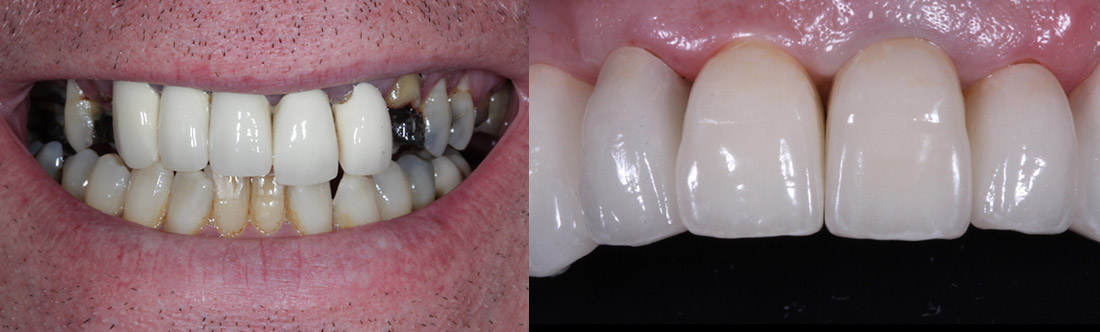
When Rick came to Dental clinic, he had a mish-mash of crowns and some missing teeth. The crowns had dark lines around the edges and some of them were loose. The appearance of his teeth had caused Rick to become highly self-conscious about his smile. Before arriving at Dental clinic, Rick was adamant that he did not want a denture. He was happy to learn during a discussion with our implant expert, Martin, that he could get dental implants; a tooth replacement that is fixed securely into the jawbone and could restore both the appearance of Rick’s smile and his confidence. It’s just like having real teeth again.
“I work with a company where everyone seems young and beautiful and everyone around me appears to have perfect teeth,” said Rick.
“I felt more and more embarrassed, I actually reached that point where I felt ashamed.”
Following his consultation, Rick had 5 implants and new crowns on the remaining teeth to give him a brand-new smile. We were able to use provisional bridges during his treatment to ensure his smile was intact while we worked on the teeth underneath. Rick was extremely happy with his results and couldn’t believe the impact his new teeth had on his confidence. Even his family members noticed the difference!
               

“My younger sister, was talking to one of my brothers and actually burst into tears,” said Rick.

“She said, ‘It’s like having my brother back,’ because I’d become so self-conscious, so ashamed, so embarrassed and just down in the mouth, literally, that it has just had a completely rejuvenating effect on me.

“ Dental clinic have just been amazing, I’m not just saying that, they really have been. From day one, everything has been explained to me, I am always put at ease.”

CAN I GET FULL DENTAL IMPLANTS IN ONE DAY?


CAN I GET FULL DENTAL IMPLANTS IN ONE DAY?


Those with multiple missing teeth can really benefit from dental implants. Without an effective replacement, missing teeth can have a knock-on effect on your everyday life. Your speech may be affected, it can limit what you eat, and it can even become painful if you are wearing replacement dentures that aren’t properly fitted. More importantly, having multiple missing teeth can really affect your confidence, especially if the gaps are located near the front of the mouth and are visible when you laugh, smile or speak.


Most tooth replacement options are a temporary solution and will not completely restore all the qualities of a real tooth. Dental implants are the only tooth replacement that can completely restore both the functionality and aesthetic appearances of your teeth, which is why they are the most popular replacement. But with dental implants being such a specialist treatment, is it possible replace multiple teeth in just one day?


What are same day dental implants?


Same day dental implants typically refer to the replacement of multiple teeth or complete upper and lower jaws. The approach uses a strategic placement of 4-8 titanium screws which are inserted into the jawbone using a small surgical procedure. Once fitted in place, a custom-made dental bridge is placed securely on top to restore the functionality and aesthetic appearance of your smile. The end result looks just like real teeth!


Although same day dental implants involve a much larger procedure than the placement of a single implant, with careful planning, expertise and cutting-edge technology, you can leave with full dental implants in one day.


Why get same day dental implants?


Anyone with missing teeth knows what a significant impact tooth loss can have on your life. Dental implants are the only treatment available that can provide an authentic replacement for real teeth and restore your quality of life. Here are some of the reasons you might want to consider same day dental implants:


Replace the cosmetic and functional qualities of your teeth


Whilst other tooth replacement options are available, dental implants are the only treatment able to cosmetically restore the appearance of your teeth and the functionality. Dentures or non-implant dental bridges can improve the aesthetic appearance of your smile, however, they are more limited in functionality. This is because they sit on top of your remaining teeth or gums and are at risk of coming loose. Dental implants, on the other hand, are surgically fixed into the jawbone making them secure. This means that they can act as fully functioning teeth as well as restoring the aesthetic appearance of your smile.


Eat all your favourite foods


Tooth loss can often prevent you from eating tough or chewy foods such as meat, crusty bread or raw vegetables, especially if you have multiple missing teeth. Many people find this embarrassing when going out for food or over to a friend’s house for dinner as you are often unable to eat certain parts of your meal. More importantly, inability to eat certain foods also prevents you from getting the full nutritional value of your meals. Your diet can become very limited and you will not be getting all the nutrients you need. With same day dental implants, you can go from having little to no teeth at all to having a full set of fully functioning teeth in the very same day. This will allow you to eat all your favourite foods and enjoy socialising again without embarrassment.


Smile, laugh and feel confident in yourself


Most people with multiple missing teeth or noticeable gaps become self-conscious about their smile. Subconsciously, you might start to become more withdrawn in social situations or cover your mouth more when laughing, smiling or having your photo taken. Same day dental implants will not only fill the gaps in your teeth, but they can also be cosmetically crafted to create your perfect smile. If you have teeth remaining, the implants can be carefully matched to the exact shape and colour of your teeth, so no one will even know they are implants at all. If you need to replace all your teeth, your same day smile can be cosmetically crafted to look as straight and white as you like. You’ll be able to smile and laugh with confidence again in no time!

Invisaligner :- Conventional Orthodontic to Well Aesthetic Biological Tooth Alignment with Invisible Aligner splints


Invisaligner is a treatment option for some orthodontic problems. Simply pop your aligner in, wear it for 22 hours a day, taking it out to brush, floss and eat. Then, as prescribed by your orthodontist move on to a new set of aligners until your teeth are beautifully straight. Seems easy, right? And it is, in a perfect world. But as we all know, we don’t live in a perfect world, and sometimes treatment is more intensive than that.If you only have a minor orthodontic issue, it can be as simple as what you have read. If you have a more serious malocclusion, though, treatment might be a little more complex.
This is where it is important that you choose a provider who has great communication skills and expertise in 3D tooth movement. Sometimes, patients go in to treatment thinking they’ll only need the aligners, only to find out their issue was a little more complex and will require attachments to correct.Before my patients agree to a treatment plan, I make sure to discuss in detail each option, and what I believe each option will entail for the duration of their treatment. There are always issues that can pop up during treatment, and teeth may not respond exactly how we thought before treatment began. However, if we can prepare the patient for as much as possible before we begin, it makes treatment much smoother and more pleasant.And for some cases, the Invisalign aligners alone cannot provide the force needed to properly move the teeth into their ideal positions. So we use attachments, also called buttons, to help us. They are essentially small, tooth-colored areas of bonding material that we place on certain teeth to help us in more difficult cases. They provide a larger area for your aligners to grip on to, and then work as anchors to move some teeth, while others stay stationary.

Attachments can provide a better result, and allow for orthodontists to use Invisalign to treat more complex cases than it would otherwise allow for. The buttons are tooth colored, so if you’re worried about people being able to see them, they’ll be almost unnoticeable.


Dental Veneers: The Secret to the Celebrity Smile


We all want white and sparkly teeth. Sadly, not all of us are blessed with good genes. We see local and international celebrities on t.v. and we long to have their pearly whites. 

The truth is that not all of those pearly whites are God-given. In most cases, these were created by a skilled dentist. But before we discuss that, let us talk about the reason most of us have yellowish or discolored teeth.

Why We Have Yellowish or Discolored Dentition

Discolored dentition may be caused by many factors. One of the most important factors is heredity. Some individuals have a thinner enamel layer than others. Enamel is the outermost layer of the crown and provides the tooth with a pearly white color. If a person has parents or grandparents with weak enamel, he or she may be born with the same condition.

Another factor to consider would be staining. Certain types of highly-pigmented food and drinks may lead to staining. Excessive consumption of cofee, tea, red wine, tomatoes and even blueberries can lead to discolored teeth. Please note that these minor stains may be removed with a good dose of in-office tooth whitening treatments. However, in cases of tetracycline-induced discoloration and other types of major staining, it would be best to consider another option.

What Are Veneers?

Veneers are wafer-thin shells that are customized by a dentist or lab technician. These are used as onlays, covering discolored or fractured teeth. This process requires the dentist to remove a thin layer of the enamel to make way for the "shell." The process is done in such a way that there is no downtime and discomfort. However, please keep in mind that patients usually have to come back after one to 2 weeks for the finished product. Temporary veneers are put in place to avoid any loss of self-esteem and embarrassment while the final veneers are being made.

A skilled dentist or technician will be able to mimic the hue and shade of the rest of the dentition. This procedure may be paired with a few tooth whitening treatments to lighten the shade of the natural teeth, unless a patient decides to have all his or her teeth capped.


Patients who opt for this procedure are usually celebrities, politicians and beauty queens. However, many dentists offer affordable rates for this cosmetic procedure. Hence, more people are able to afford this type of treatment. These days, more new-grads and college students are getting veneers done to give them an edge when they join the workforce. Pearly white dentition is a dream that is becoming quite attainable these days. 

If you want to boost your self-confidence, consult a skilled dental expert today!