Showing posts with label dental cosmetic. Show all posts

Tuesday, November 20, 2018

ADULT ORTHODONTICS


Overview

Orthodontics is a specialty discipline of dentistry that focuses on alignment of the teeth and jaws to improve a person’s smile and oral health. Orthodontists will diagnose, treat and prevent irregularities of the teeth with the use of braces, which are fixed dental appliances, and removable dental appliances, when the braces are removed. These devices can be used to straighten teeth, correct an irregular bite, close unsightly gaps and bring teeth and lips into proper alignment. Crooked teeth that do not fit together correctly are harder to keep clean and are at risk of being lost early because of tooth decay or periodontal disease.


Benefits

The benefits of orthodontics include a healthier mouth, a more pleasing appearance, and teeth that are more likely to last a lifetime.


Care

Good oral hygiene is especially important when you have braces or other orthodontic appliances. Brushing twice a day with fluoride toothpaste for two minutes, flossing daily, and scheduling ongoing dental visits are all important to help keep the gums and teeth healthy.

Patients with braces should maintain a balanced diet and limit sugary snacks between meals. Your dentist may recommend avoiding certain foods that could interfere with braces or accidentally bend the wires, such as nuts, popcorn, hard candy, ice and sticky foods, such as chewing gum, caramel or other chewy candy.


Procedure

There are a variety of options, both fixed and removable, which help move teeth, retain muscles and affect the growth of the jaws. They work by placing gentle pressure on the teeth as they move in the jaw bone.

Traditional Braces

The most common fixed treatment option, braces consist of brackets, elastic bands and an arch wire. Brackets are bonded to the front of the tooth and used as anchors for the braces. Arch wires are placed through the brackets and small elastic bands secure the arch wire in the bracket. Tightening the arch wire puts tension on the teeth, gradually moving them into proper position. Orthodontists adjust braces every 4-6 weeks to bring about the desired results, which may be achieved in one to three years.

Today's braces are smaller, lighter and show far less metal than in the past. They come in bright colors for kids, and clear styles preferred by many adults.

Once braces are removed, a retainer is worn on both the upper and lower jaws (or where the braces were placed originally) for at least one year to hold the teeth into place in their new position.

Although a little discomfort is expected during orthodontic treatment, today's braces are more comfortable than ever before. Newer orthodontic techniques and materials have been developed to move teeth in a shorter period of time.

Here’s an overview of some of the other orthodontic treatment options:

Damon Braces

Damon braces are self-ligating appliances, meaning that instead of using elastic bands to attach the arch wire to the bracket, the brackets use a slide mechanism. This eliminates the need for elastic bands, which cause friction and can slow down treatment. With damon braces teeth can move into place more freely so treatment time is decreased. Damon braces are more aesthetically pleasing because the brackets are less noticeable than traditional metal brackets. The downside is that damon braces are usually more expensive than traditional braces. Consult with your orthodontist to find out if damon braces are a good option for you.


Invisalign

Invisalign is a set of custom-made clear plastic aligners, which are designed to shift your teeth into the proper position. About twice a month, the patient switches to a new set of aligner trays, repeating this until their teeth are in the correct position. Invisalign is intended to deliver the same benefits as traditional braces but the aligner trays are less noticeable, offering an aesthetic advantage. The aligners are removed for eating, brushing and flossing, and may not take as long to achieve good results as braces during orthodontic treatment.

Lingual Braces

Lingual braces, also called invisible braces, are placed on the interior side of the teeth (by the tongue and palate) and are a great option for people concerned about their appearance. Similar to traditional braces, teeth are straightened using continuous gentle pressure to help them slowly shift into the proper position. Lingual braces involve more customization and may be more expensive than traditional braces.

Although treatment plans are customized, most people wear braces from one to three years, depending on their individual needs and the position of their teeth and occlusion.

What Are Dental Crowns And Tooth Bridges?


What are Dental Crowns and Tooth Bridges?

Both crowns and most bridges are fixed prosthetic devices. Unlike removable devices such as dentures, which you can take out and clean daily, crowns and bridges are cemented onto existing teeth or implants, and can only be removed by a dentist.

How do Crowns Work?

A crown is used to entirely cover or "cap" a damaged tooth. Besides strengthening a damaged tooth, a crown can be used to improve its appearance, shape or alignment. A crown can also be placed on top of an implant to provide a tooth-like shape and structure for function. Porcelain or ceramic crowns can be matched to the color of your natural teeth. Other materials include gold and metal alloys, acrylic and ceramic. These alloys are generally stronger than porcelain and may be recommended for back teeth. Porcelain bonded to a metal shell is often used because it is both strong and attractive.

Your dentist may recommend a crown to:

Replace a large filling when there isn't enough tooth remaining
Protect a weak tooth from fracturing
Restore a fractured tooth
Attach a bridge
Cover a dental implant
Cover a discolored or poorly shaped tooth
Cover a tooth that has had root canal treatment

How do Bridges Work?

A bridge may be recommended if you're missing one or more teeth. Gaps left by missing teeth eventually cause the remaining teeth to rotate or shift into the empty spaces, resulting in a bad bite. The imbalance caused by missing teeth can also lead to gum disease and temporomandibular joint (TMJ) disorders.

Bridges are commonly used to replace one or more missing teeth. They span the space where the teeth are missing. Bridges are cemented to the natural teeth or implants surrounding the empty space. These teeth, called abutments, serve as anchors for the bridge. A replacement tooth, called a pontic, is attached to the crowns that cover the abutments. As with crowns, you have a choice of materials for bridges. Your dentist can help you decide which to use, based on the location of the missing tooth (or teeth), its function, aesthetic considerations and cost. Porcelain or ceramic bridges can be matched to the color of your natural teeth.

How are Crowns and Bridges Made?

Before either a crown or a bridge can be made, the tooth (or teeth) must be reduced in size so that the crown or bridge will fit over it properly. After reducing the tooth/teeth, your dentist will take an impression to provide an exact mold for the crown or bridge. If porcelain is to be used, your dentist will determine the correct shade for the crown or bridge to match the color of your existing teeth.

Using this impression, a dental lab then makes your crown or bridge, in the material your dentist specifies. A temporary crown or bridge will be put in place to cover the prepared tooth while the permanent crown or bridge is being made. When the permanent crown or bridge is ready, the temporary crown or bridge is removed, and the new crown or bridge is cemented over your prepared tooth or teeth.

How Long do Crowns and Bridges Last?

While crowns and bridges can last a lifetime, they do sometimes come loose or fall out. The most important step you can take to ensure the longevity of your crown or bridge is to practice good oral hygiene. A bridge can lose its support if the teeth or bone holding it in place are damaged by dental disease. Keep your gums and teeth healthy by Brushing with fluoride toothpaste twice a day and flossing daily. Also see your dentist and hygienist regularly for checkups and professional cleanings.

To prevent damage to your new crown or bridge, avoid chewing hard foods, ice or other hard objects.

Crowns

 
                    Full porcelain fused to metal.


                           Full cast gold crown.


Bridges


Teeth around the space are prepared. 

The bridge is mounted and adjusted for fit and comfort. 

The bridge is cemented into position.


“LOSING YOUR FRONT TEETH IS REALLY QUITE TRAUMATIC. BEING ABLE TO HAVE THAT BACK HAS MADE SUCH A DIFFERENCE”


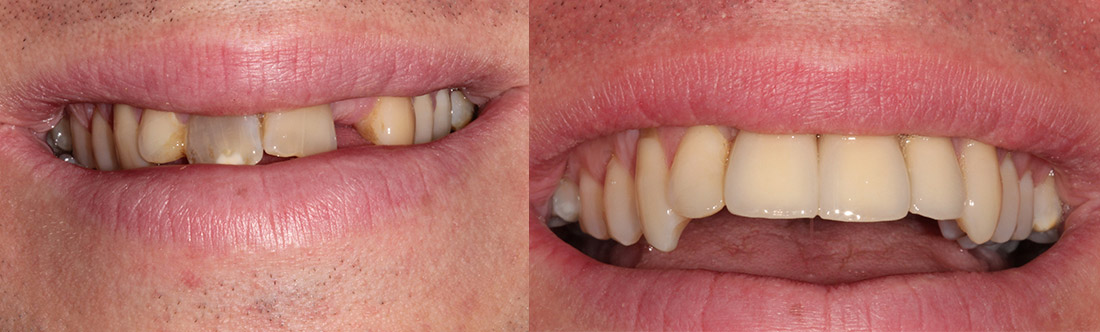
After cracking his front three teeth during a round the world yacht race, Daniel opted for a replacement denture to help with the aesthetic appearance of his smile. Living with a denture, however, was proving extremely difficult and uncomfortable. He couldn’t eat certain foods and as a naturally active and sociable person, he felt the denture was limiting his lifestyle. Daniel came to Dental clinic  after a friend recommended dental implants. After a consultation with  Dental implantologist , Daniel agreed that, as a permanent and fixed solution, implants were his best option.

“I did a round the world yacht race, had an accident and cracked my front three teeth.” Said Daniel.

“One of the three teeth had really started to go black and it was affecting my confidence, I was having to be careful about what I ate. Fortunately, a friend of mine, who had recently just finished having an implant, mentioned that she’d come here to  Dental clinic .”

Daniel’s treatment involved 3 implants to replace his front 3 teeth, along with some tooth whitening to brighten the colour of his remaining teeth. The outcome was a winning smile and the ability to eat whatever he wanted without the worry of his denture slipping or coming out.


“I was absolutely so pleased, it made such a difference,” said Daniel. “To be able to smile in photos and the lovely feeling of crunching on an apple properly, putting it in your mouth and hearing the crunch, savouring it and knowing that you’re not going to have a denture come out, it’s great. fantastic.

“I’ve just been really impressed with everything  Dental clinic have done in terms of the professionalism, the friendliness as well. They’ve really helped me through what was quite a significant event in my life. Effectively losing your front teeth is really quite traumatic, it takes so much from people’s faces and being able to have that back has made such a difference.

“I would so recommend anyone else who’s in the same position, just do it. It just takes the worry away from you.”